Shifting Beyond the Past
Introduction:
Humanity is potentially on the verge of self-destruction and social collapse, largely due to the extractive practices of our economic system which have put the balance of natural order out of kilter ….. witness the climate crisis, our polarised societies, brutal wars, unnatural disasters and the phenomenal (but unspoken) rates of suicide. It is widely acknowledged that the patriarchal leadership styles that had appeared to work well in the past are, in a current world of complexity, no longer fit for purpose (if they ever were).
To survive and thrive in the 21st-century humanity, society, organisations, communities and individuals need a new set of skills which enable us to work collaboratively in a context of unpredictability and complexity. The knowledge and skills we learned at school are no longer serving us; they were mainly based on a mechanistic world view, which is largely predictable, and where complicated problems could be solved by a few experts, backed by a bureaucratic system that keeps everything neutral and stable. We now live in an unpredictable and volatile world, which is complex and ambiguous, requires different skills and capacities for social coordination and co-creativity, and asks all of us to be engaged with it.
Some of the new skills include: interpersonal skills, deep listening skills, relational skills, dialogue & emergence, perspective coordination and integration skills, team self-organising skills, both-and thinking, open living systems thinking, meta-communication, contextual thinking, design thinking, regenerative skills, collaborative decision-making and humility (Vulnerability). We must shift away from our adversarial win-lose approach towards full-on cross-institutional collaboration. And leadership needs to reflect this new reality.
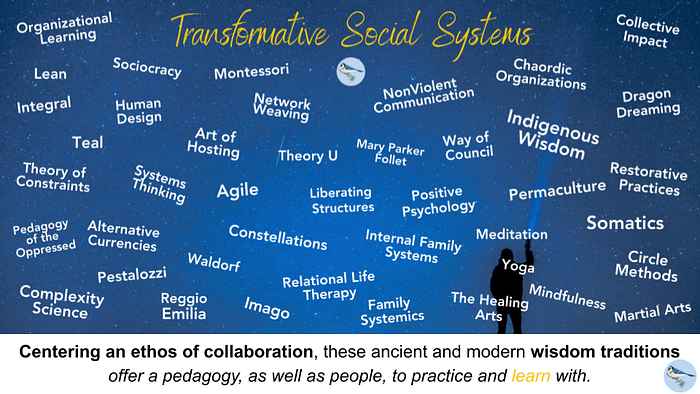
Many great methodologies, such as lean, agile, sociocracy etc., have emerged addressing these skills. They have, however, largely remained on the fringes in isolation, with insignificant social impact. In response, Pascale Mompoint-Gaillard, PhD, and Laureen Golden, MEd, have developed the concept of Transformative Social Systems (TSS), which, in their words, “is a name for a category of ancient and modern wisdom traditions which centre an ethos of collaboration.” This article represents my take on TSS.
Laureen Golden and I have written a critique (How to develop future Leaders: Preparing Leaders to Navigate Uncertainty and Exponential Change) of an HBR article about The Future of Leadership Development, cross-referencing TSS to it briefly. Here, I shall review TSS as I see it and use the HBR article as a benchmark to cross-reference the two pieces in more detail. As the HBR article is about the future of Leadership Development, I shall be looking at TSS through the Leadership Development lens, exploring what implications TSS could have on Leadership Development. Specifically, I want to show why TSS is not just another method or approach, but rather a transdisciplinary framework for working with multiple methods. TSS requires a complete paradigm shift in thinking to enable us to reinvent “leadership”.
A brief overview of TSS
“Transformative Social Systems” (TSS) encompass a range of practices, methods, and techniques that foster meaningful, connected, and life-enriching ways of collaborating. These systems draw from both ancient traditions — such as indigenous practices, martial arts, and philosophies like Confucianism and Taoism — as well as modern methodologies like Agile, Lean, Sociocracy, and Non-Violent Communication. By engaging in deep dialogue and reflective listening, TSS facilitate a profound meeting of hearts and minds, enabling access to collective wisdom essential for addressing contemporary challenges.
The rapid external changes in today’s world have surpassed our internal capacities to manage them, creating an urgent need to accelerate learning across all demographics. TSS offer the tools necessary to bridge this gap, promoting “power-with” relationships and a collective sensitivity to emerging dynamics within groups. This approach enhances our ability to learn collaboratively, potentially at an exponential rate, thereby aligning our internal capabilities with external complexities. A forerunner of TSS could be the work of Peggy Holman et al. in The Change Handbook, 2007 (2nd edition), for engaging whole systems.
Despite their potential, TSS practices often exist in isolated silos, hindering cohesive collaboration across social action fields. To address this, the authors advocate for increased awareness and integration of TSS, encouraging practitioners to connect, share, and learn the core elements of these systems. They propose the creation of informal, peer-learning environments to facilitate this process, necessitating a reevaluation of individual and collective learning approaches.”
Does TSS live up to HBR parameters?
Harvard Business Review published the article in 2019, mentioned above, looking at The Future of Leadership Development. It explores the current state of leadership development as found in academia (business schools, MBAs), consultancies (strategy, HR), and private educational institutions (corporate universities, leadership training providers), and finds that most leadership development programs at business schools and consultancies are woefully out of touch with the current needs. A few private organisations are introducing what the authors called PLCs, Personal Learning Clouds, which enables leaders to learn at their own pace, drastically reducing cost. It also makes it possible for a much larger cohort of people to develop their leadership skills (the authors had argued that leadership would become distributed and that concentrating on developing just for the top C-suite was out of date). The article emphasises the need to expand the learning methodologies, as well as to focus far more on what they call the “communicative, interpretive, affective and perceptual skills needed to lead coherently, proactively and collaboratively”.
In a critique of this article, Preparing Leaders to navigate uncertainty and exponential change, we argue that the article was going in the right direction, but that if future organisations were to focus more on co-creation, sense-making and collaboration, then the principle of Personal Learning Clouds was somewhat counter-productive, because the focus is still on personal and individual learning and development, and that what is needed is a focus on people working with each other in collaboration, that is learning to work collaboratively. As this can only be done in community, we proposed what we called Community Learning Clouds instead, or Community Learning Circles.
While we will consider TSS, in the context of leadership development, in its own right, let us first briefly review how TSS fares through the parameters offered by the HBR article, in the context of PLCs. The original HBR article established 4 key characteristics of PLCs, notably that learning is personalised, socialised, contextualised and can be tracked and authenticated. As a commentary, we would like to add a few cautions to each of these characteristics:
- Learning is personalised. While to a certain degree this should be true, it must be moderated, as there is a danger of falling too deep into the trap of individualised learning and personal knowledge, rather than working on learning together.
- Learning is socialised. Yes, this is true, the focus is on the collective, the common good and our ability to co-exist and co-create, and this can only be developed by learning together.
- Learning is contextualised. We would agree that TSS is indeed highly contextualised; in fact, contextualisation is the sine qua non of future learning, rooted and embodied in what we do as a collective.
- Learning outcomes can be transparently tracked and authenticated. Feedback loops are critical in terms of being able to assess the work of a collective, and we support that. At the same time, we would urge caution on being too data-driven or algorithm-driven, as this could stifle emergence by being too outcome-oriented.
Thus these 4 parameters, while necessary, do not fully capture the degree of change that is needed to reinvent leadership.
Applying TSS to Leadership development?
Most leadership development, as currently practised, tends to focus on current C-suite leaders (in the case of corporations) or chiefs in public or educational institutions, as well as a select number of people who have been identified as having leadership potential in those institutions. The assumption is that the future will largely be driven and governed by such a select set of people who hold power over the people they lead in those organisations, largely following current practice. In this context, leadership development is thus determined by the skills and knowledge that these leaders have or need to be able to do that.
This assumption, however, completely flies in the face of what our world needs. Our poly-crisis is largely driven by such a myopic view of leadership, where all major decisions are taken by a select group of people, often serving their own purpose. This worked to a certain degree in a mechanistic world where things were predictable and goals could be achieved by pulling a few levers. Our real world, however, is completely different, highly unpredictable and complex, and requires a completely different set of skills, as set out in the TSS article and elsewhere.
This calls for broadening out leadership development and broadening our attitude away from a mentality of a few select people to everyone being involved in co-creating the world collectively in their own contexts. Thus, a fundamental difference is that leadership should no longer be seen as the premise of a few select people, but is very much a social or community responsibility. This means that anyone, or any group of people, at any time could be asked, or take the initiative, to take on some form of leadership role for a short time. Everyone in an organisation has to be able to ‘lead’ at some point, and therefore everyone has to have some form of leadership development.
Because leadership has to shift from being about some “select” people (elite) planning and then telling others what to do, to one of facilitating groups in collaborative decision-making and problem-solving, a completely different set of social skills is required, such as co-sensing, co-creation, dialogue, perspective coordination and conciliation. Note that these skills can only be learned through practice with others. These skills have generally not been taught in our current education programs. Hence, the way leadership development is practised needs to be radically different from what it has been in the past.
The biggest difference from what is currently practised can be summarised as follows:
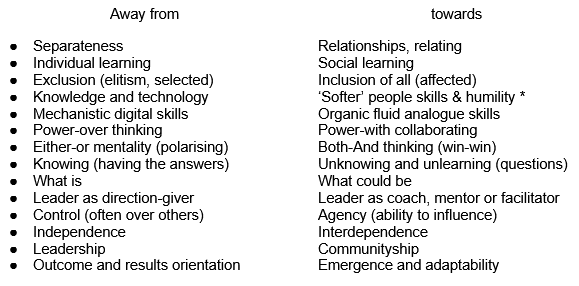
- * People skills have often been referred to as “soft skills”. This is indicative of the derogatory attitude emanating from alpha-macho-type leadership. These ‘soft’ skills are usually the hardest of all, which is why they are often mentioned last and usually not taught in leadership development programs (in the West) at all. What the world needs from leaders is for these ‘soft’ skills to come right to the top of the list of priorities.
Why TSS calls for a paradigm shift in thinking
It is clear from the above list that this is not just ‘business as usual with some slight tweaks’, but a completely different way of looking at leadership. It reflects a paradigm shift in thinking, requiring us to redefine leadership. I hesitate to say a shift to a new kind of thinking because the thinking we need can be found in old indigenous practices, as well as in Asian practices like Buddhism, Shintoism, Confucianism and Taoism, all of which focus more on the collective. In other words, there is nothing new, but it has largely been repressed in the West in recent history, the legacy of colonialism and capitalism.
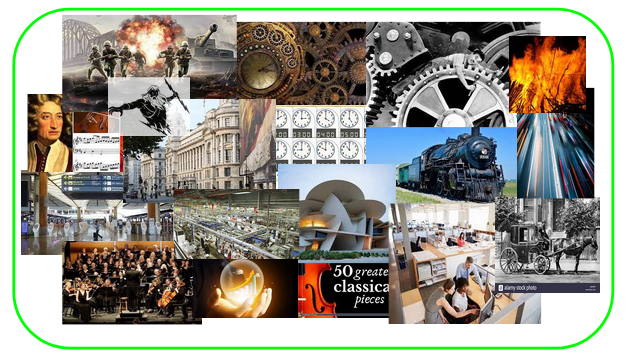
We might find inspiration from the endeavours of quantum leadership and communityship, which have grown directly out of Western research. The diagram below illustrates some of the shifts that are needed to move from a mechanistic (predictable) world to a quantum (volatile, organic) world, which involves us all equivalently in the co-creation of our world.
The different perspectives between the Newtonion simplification (and let us remind ourselves that the whole premise of Newtonian physics is highly simplified, viewing the world as things happen in a vacuum … but we don’t live in a vacuum!!!) and the quantum world, and how this leads to different kinds of organisation, institution and government body are shown below:
Shifting from Newtonian to Quantum organising principles
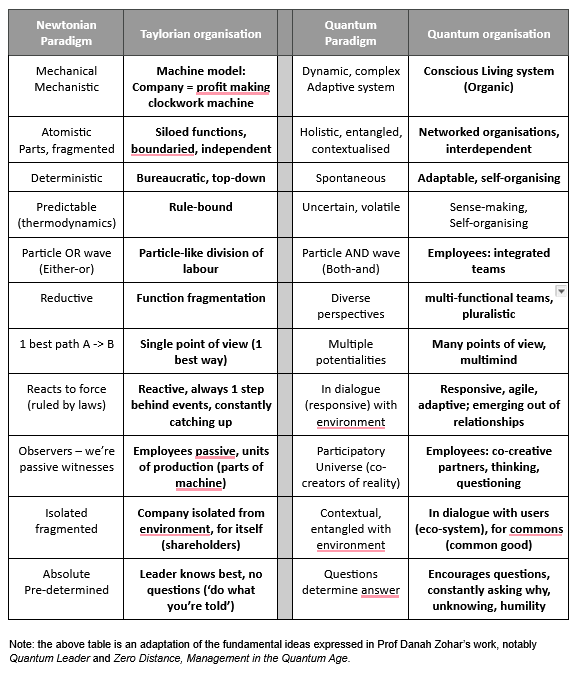
The kind of leadership found in institutions based on Newtonian thinking differs substantially from that based on quantum thinking. The Newtonian oversimplified view of the natural world has led to the extractive practices found in our history of colonialism, slavery, violence, exploitation and capitalism, on a path of self-destruction. It is becoming clear that we need a more balanced, holistic quantum perspective of leadership.
Following on from quantum thinking and its principle of interconnectedness and interdependence, it follows that leadership must be very much aligned with the social eco-system it operates in, and not by the ego-centred perceptions of any single person, however intelligent. Ancient Chinese philosophy has emphasised the need for leaders to be in the right energy vibrations to be able to lead people benevolently, and this principle is anchored in Confucian philosophy. Max Yong of Hong Kong University has translated that for Western minds using David Hawkin’s Map of Consciousness. Leadership development can then be seen as a way of elevating people’s heart frequency levels from fear, anger and desire on the negative side to peace, love and joy on the positive side.
Since anyone could be called to lead, everyone should be educated in raising their level of consciousness at a young age. With this approach, the success of any future leader can be predicted by the degree he or she can move up the energy vibration scale, from fear to love. A Western parallel to this thinking can be found in the work of MIT Otto Scharmer, who talks about the ability of leadership being dependent on the place (or frequency) a leader is coming from. Instead of love and fear, he talks of presencing and absencing.
Indeed, emergence, improvisation, embodiment, ……. are all elements of future leadership development. At the same time, leadership development also needs to descend from its high pedestal position to the more commonplace. Overall, a seismic shift in thinking.
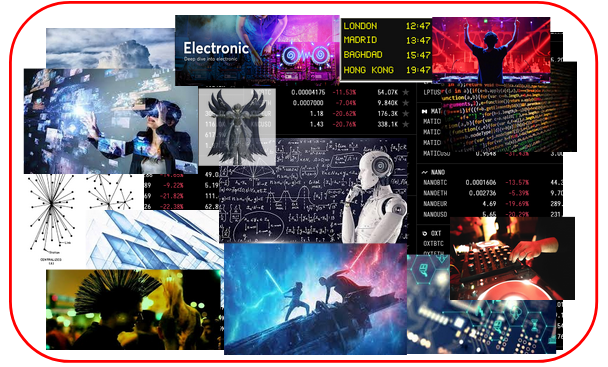
Actions for shifting the purpose of education (Learning Labs)
Taking the idea of CLC, Community Learning Cloud or Circle, learning together, self-organised learning (Mitra Sutra) and Open Space Technology, we propose to combine them into Learning Spaces where people can self-organise to learn social skills and collaboration together, to learn with other people, socially, collaboratively, together.
The purpose of collaborative learning centres can be seen as multifold: On one hand, they promote social learning, so learning becomes a symbiotic endeavour of joy, rather than a drudgerous chore. This, in turn, makes it a lot easier for people to learn to work with and help each other, rather than outwit each other competitively to get to the top. Moreover, the learning centres can specifically focus on those particular skills that can only be learned by doing or practising together.
We propose, and have created prototypes for, “ Learning Labs “. These are spaces where people from a learning network can come together and practice new skills, self-organising themselves amongst those who show up. This means that every time participants may practice with different participants, and are thus less likely to become fixated on the habits of a particular set of participants. The Learning Labs are online and are specific to a particular organisation, though having civic community Learning Labs is also possible.
The Learning Labs could be part of an Organic Learning Centre designed to enable the organisation’s people, at whatever level, to learn basic new skills required to function in the “new economy”. The underlying principles are: human-centric; holistic; service-oriented (service to the community); eco-systemic, and embracing diversity and paradox.
The Learning Labs are not intended to be education/training stand-alones (as are classes or communities of practice), but they are very much part of a wider learning community or organisation, and should be accessible by all members of that community. This means there is a vast pool of available learners to learn with, allowing for serendipitous cross-functional co-learning. Lab sessions can be run with a learning facilitator, or by the learners teaching each other and practising themselves in a self-organised way.
The Learning Lab principle is intended to supplement existing programmes, not replace them. Indeed, individualistic skills can continue to be taught through PLCs or other ways — there is still a place for traditional learning programs, they just need to be contextualised. What we are trying to address here is what is missing in conventional leadership development programs and present alternative ways they could be learned.
Co-creating our future, starting with imagination and dialogue
Beyond the skills and competencies we need to learn together, we also need to open our eyes and nurture our innate curiosity. The work of IDG (Inner Development Goals work) may help. Fundamentally we need to rekindle our innate curiosity within us — reawaken our curiosity which we lost at the doorsteps of our schools in childhood when we were told what and how to learn, and be tested for, instead of being encouraged to pursue our innate curiosity (most adults never regain their lost sense of curiosity) to learn ourselves (Lexica skills), discovering together with fellow pupils in our school community.

Toyota is famous for introducing ‘lean’ and achieving great results. Toyota’s success, however, is less due to its ‘lean’ techniques and has much more to do with its ability to re-instil curiosity and questioning in all of its employees. Toyota’s constant quest is for reframing and relearning …. not answering questions but asking new questions and learning to learn. As Mr Yoshino says in the book by Kate Anderson, Learning to Lead, Leading the LEARN : Lessons from Toyota Leader Isao Yoshino on a lifetime of continuous learning, “The only secret to Toyota is its attitude towards learning” (and not techniques and know-how).
We need to reinvent our world in a way that works for all, or in multiple diverse plural ways. Co-creation is a paradigm. Underlying co-creation is co-imagination. Part of future leadership development will be imagining together, what Phoebe Tickle has called “Moral Imagining”. In the spirit of collaborative co-creation, we should have cross-disciplinary dialogue, in the Bohmian Quantum sense. Useful tools could be the Cards for Democracy and our collective ability to meta-communicate. Finally, an ethical dimension should be revived, as explored more deeply in the quest for good leadership.
In short, leadership development is not about imparting knowledge or techniques to self-selected cohorts of elites. Instead, it is about social facilitation (or coaching), social learning (learning with others), collaborating, being with and for the commons or community, and most importantly, operating from the depth of love, letting people have agency and leading without authority. We must remove force and violence from leadership and encourage co-learning instead. This is one of the key lessons Edward W Deming (TWI) learned when “training” women volunteers (who could not be forced to do anything) working in US arms manufacturing during the second world war, lessons subsequently lost, even derided, when the men returned to the factories at the end of the war. Ironically, such lessons were later picked up by Japanese manufacturers, like Toyota and Suzuki, who created “armies of problem-solvers” by actively engaging the workforce, rather than directing them as if they were children. The key shift that needs to happen in the future of leadership development is democratising leadership, removing authority over others, and encouraging leading through conversation and dialogue.
All this requires us to create spaces where dialogue, co-imagination and co-learning can take place. TSS, with its multiple methods and approaches, are contributing towards enabling such spaces. While it is clear we need to redefine what leadership is and how it is developed, it is not for me or anyone else to define the new; I have merely tried to show some examples of what that might look like. Ultimately, it is a conversation we all need to have, we need to co-define what leadership and leadership development should be together. Let’s talk!
 GoFish! Collective