
The article emphasizes a necessary paradigm shift in leadership and collaboration, advocating for a more inclusive, community-focused approach over traditional patriarchal models. It introduces Transformative Social Systems (TSS), emphasizing skills like co-creation and deep listening. The authors call for democratic, collective leadership development that transcends individualism and encourages cooperation for tackling contemporary challenges effectively.
Category Archives: Uncategorized
Unlearning Education: From Control to Curiosity

The GoFish! Collective examines the systemic issues in modern education, highlighting control, conformity, and fear as barriers to creativity. They argue that traditional models prioritize obedience over curiosity, leading to anxiety and disconnection among students. The conversation emphasizes the need for transformative, presence-based education that nurtures individual potential and fosters inquiry.
The Paradox of Change: Why We Resist What We Want

The author explores the disconnect between perceived professionalism and authentic interactions, highlighting how fear perpetuates inauthenticity in workplace settings. It argues that this disconnection drains energy and fosters burnout. By confronting fears and recognizing shared struggles, individuals can foster connection and understanding, breaking down barriers and enhancing emotional freedom.
🎣 GoFish! Collective Reflections on Control and Emergence

The article presents a dialogue among the GoFish! Collective on the theme of control and its impact on emergence and leadership. Participants reflect on their experiences with control, its roots in fear, and the importance of shifting perspectives from an ego-centric to an eco-centric approach. They advocate for allowing diverse perspectives and embracing uncertainty for better outcomes.
Emergence vs. Structure: A Collective Reflection

A collective reflection from GoFish! CollectiveBy Joanna Staniszewska with Katrin Shaw, François Knuchel, and Brett Sadler In a recent GoFish! Collective conversation, we didn’t set out to discuss time. But like many important things, the topic emerged on its own — uninvited but necessary. We found ourselves sitting inside a shared tension: calendars that overflow,ContinueContinue reading “Emergence vs. Structure: A Collective Reflection”
Rethinking Perception, Beliefs, and Social Consensus

The Silent Choir of Art: How Creation Awakens Our Humanity Art, music, poetry, painting, sculpture, film, and performance—what do they all have in common? They emerge from within us, breathing life into what might seem impractical but, in reality, has the power to move, uplift, and release emotions. Art plays on the strings of ourContinueContinue reading “Rethinking Perception, Beliefs, and Social Consensus”
Tapping Into Another Dimension: Business Growth Beyond Transactions

We are obsessed with metrics, conversions, and aggressive marketing tactics. We often forget that true business growth isn’t just about selling—it’s about connection, purpose, and authenticity. The GOFISH! Collective latest discussion revealed a deeper truth: sustainable success comes not from chasing clients but from creating spaces of trust, alignment, and belonging. Beyond the Scarcity MindsetContinueContinue reading “Tapping Into Another Dimension: Business Growth Beyond Transactions”
Zoom on Emergence: a GoFish! Collective conversation

The GoFish! Collective meeting highlighted the balance between structure and surrender, exploring the themes of control, emergence, and the importance of psychological safety. Members shared personal reflections, emphasizing the necessity of trust and curiosity in fostering genuine collaboration. The dialogue revealed that meaning is co-created, relying on interpretation and engagement.
Emergence: the balance between control, curiosity, and safety
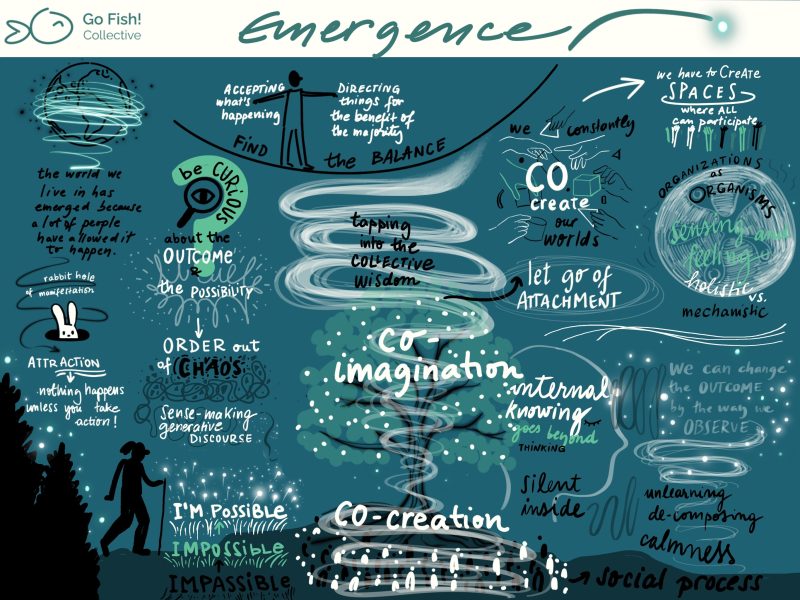
In the first episode of the GoFish! Collective podcast, hosts explore emergence’s relationship with control, safety, and curiosity. They discuss how trust influences participation and innovation, emphasizing the need for inclusive dialogue to foster true emergence. The conversation raises questions about balancing guidance and allowing organic development in social constructs.
Where are we at? Insight into the collective state.

GoFish! Collective’s meeting highlighted the significance of open dialogue in fostering organizational success. Members Kat, Joanna, Francois, and Brett candidly discussed challenges and frustrations, emphasizing the need for sustained energy, mutual accountability, and a clear collective vision. Their reflective approach showcased how vulnerability can drive transformative change within the group and community.
How to develop future Leaders:

Leaders and organizations encounter challenges in today’s fast-changing world. The need for new leadership skills to adapt to volatile, uncertain, complex, and ambiguous environments is urgent. Developing leadership capabilities for a broad range of employees is crucial, but traditional education pathways may not meet current demands. New methods for delivering education, such as the Personal Learning Cloud (PLC), provide customizable and effective options. However, there is a call for more emphasis on social, embodied, holistic, scaffolded, and dynamic learning experiences to prepare leaders for the complexities of today’s world.
Distributed leadership in practice

The case study examines a creative agency facing high turnover, stressed management, and disengaged employees. After implementing distributed leadership, where teams set their own targets and make their own decisions, the company saw reduced turnover, lower sick days, improved client satisfaction, and increased revenue and profitability.
Embracing Complexity in Organisations

In today’s increasingly complex world, traditional leadership models struggle to address the challenges brought forth by VUCA (Volatility, Uncertainty, Complexity, Ambiguity). The current hierarchical management methods are counter-productive, exacerbating the challenges of VUCA. To thrive in this environment, organizations and individuals must develop VUCA skills, embrace rich interconnectivity, and cultivate adaptive leadership.
Get started with self-management

Companies that prioritize employee happiness and trust see increased success. Taking a self-management approach and focusing on Maslow’s Hierarchy of Needs can lead to improved motivation and financial stability. By giving employees autonomy and addressing their basic needs, organizations can foster engagement and productivity. Encouraging innovation and change can further enhance teamwork and performance.
From Force to Flow

The blog post emphasizes the shift from traditional to modern thinking, advocating for empowerment over control in leadership. It promotes self-managing teams and autonomy, urging leaders to embrace change for 21st-century success. The author encourages readers to join the Reinventing Work movement, promoting organizational evolution and empowerment.
Stress Cleanse Your Workplace

Stress in the workplace is most often due to difference between reality and expectations. Leaders can reduce stress by being authentic and valuing individuality. Creating a low-pressure environment helps to produce a “flow” state, which increases individual and team performance.
The Emerging Role of the CVO

CEOs are facing challenges as the future becomes more uncertain due to rapid technological change and shifting workforce dynamics. The Chief Visionary Officer (CVO) role emerges to provide a broad-picture vision, empowering employees to adapt and take ownership. Embracing this approach, CEOs must prioritize values and standards over operational details to stay competitive.
How to improve your talent retention and attraction: what employees want

This post discusses employee turnover and offers advice for improving talent retention. It covers red flags to avoid in the workplace, green flags to look for, and key questions to ask employees. Emphasizing the importance of autonomy, clear goals, and support, it suggests treating employees like adults and focusing on engagement to retain talent effectively.
What makes a brave leader?

Brave leaders support their team with transparency, trust, and empowerment, allowing them to align with the organization’s purpose and make decisions. This nurturing environment encourages learning through experimentation and tolerance of failure. Leaders also provide the necessary resources and technology for effective communication and decision-making.
Organisational Culture – Embodied Learning in a New Simulation

Participants of an online people simulation exploring organizational culture found the experience fun, challenging, and eye-opening. By immersing themselves in different organizational cultures, they gained valuable insights into collaboration, team building, and the impact of cultural norms and behaviors on individuals. The simulation provides a unique, embodied learning experience, making it a powerful tool for navigating organizational change and fostering deep conversations and new possibilities.
 GoFish! Collective