
Social Learning in Self-organised Organic Learning Centre
To survive and thrive in 21st-century humanity, society, organisations, communities and individuals need a new set of skills that enable us to work with unpredictability and complexity. The knowledge and skills we learned at school are no longer serving us; they are mainly based on a mechanistic world view which is largely predictable, with complicated problems that can be solved by a few experts and managers and a bureaucratic system which keeps everything neutral and stable.
We now live in an unpredictable and volatile world, which is complex and ambiguous, and requires a different set of skills and capacities and the co-creativity of all. Our current education system does not cater to these needs and is thus not only not fit for purpose, it is also counter-productive, even destructive. While our education system needs a complete reinvention, we cannot wait for the next generation to resolve our current cumulative multiple simultaneous crises — we adults have to re-educate ourselves now.
Some of the new skills we need to learn are summarised in this Social Kata Skills for New Economy / Next-Stage Organisations sheet. For example, this includes: Interpersonal Skills, Deep Listening Skills, Relational Skills, Dialogue & Emergence, Perspective Coordination / Integration Skills, Team Self-organising Skills, Both-And Thinking, Open Living Systems Thinking, Contextual Thinking, Design Thinking and Humility (Vulnerability), shifting away from our adversarial approach, towards full-on cross-institutional collaboration.

What is particular about these new skills is that many of them cannot be learned in the classical way we learned other skills at school, i.e. on our own in discreet testable chunks. These are very fluid skills that cannot be learned by oneself, they can only be learned together with others, much like team sports or social dancing. The learning itself is a collaborative effort. We are ill-prepared to learn in this way, as it is not something our education system, focussed very much on individual learning, testing and competition, has equipped us with. In other words, learning itself has to be re-learned. I call this new style of learning ‘Social Learning’.
The new skills that need to be learned may vary from person to person, from team to team and from organisation to organisation. Nowadays it is quite common to have “Communities of Practice”, which are small communities that practice certain skills together. They are generally, however, quite homogeneous, i.e. members do not vary a great deal. This can be both positive and negative: Positive because the same group can gain deeper learning and behave more coherently together; Negative because we find that for these new skills to be mastered well it is also necessary for people to practice with a diversity of people, learning to adjust to different personalities and their styles, and disrupting habits gained from working with just one set of people. This is like the new learning that occurs every time partners change in social dancing.
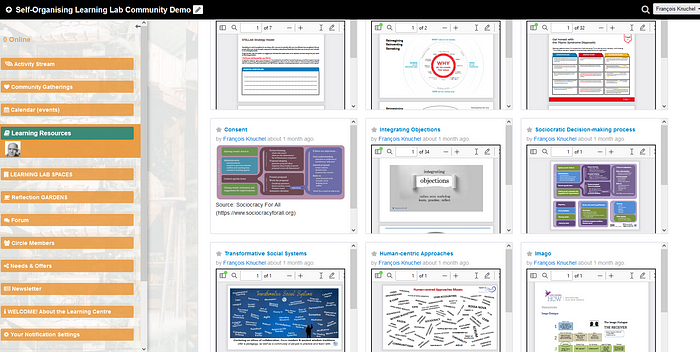
For this reason, we are proposing, and have created prototypes for “Learning Labs”. These are spaces where people from a learning network can come together and practice new skills, self-organising themselves amongst those who show up. This means every time participants may practice with different participants, thus creating a natural diversity. They are thus less likely to become fixated on the habits of a particular set of participants. The Learning Labs are online and are specific to a particular organisation, though having civic community Learning Labs is also possible.
The Learning Labs could be seen as an Organic Learning Centre designed to enable the organisation’s people, at whatever level, to learn basic new skills required to function in the “new economy”. The underlying principles are: human-centric; holistic; service-oriented (service to the community); eco-systemic, and embracing diversity and paradox.
The backbone to what learners are learning together are several sub-routines, each learned separately at first and then combined, also called ‘Kata’ as in Japanese martial arts. While clumsy and ‘unnatural’ to begin with, once learned and consolidated (neural connections wired and reinforced) these ‘katas’ become automatic, in the same way operating the clutch and accelerator are automatic once learned — we do them without thinking about them, they become ‘natural’. These ‘katas’ would be described in the learning materials provided, like little recipes, except that in this case we are dealing with social interactions, what I call ‘Social Kata’. The Learning Labs would also have spaces for deep dialogue where learners can reflect on the learning together in an emergent way.

The Learning Labs are not stand-alone workshops (as are classes or communities of practice), but are very much part of a wider learning community or organisation, and can be accessed by all members of that community. This means there is a vast pool of available learners to learn with, allowing for serendipitous cross-functional co-learning. Lab sessions can be run with a learning facilitator, or by the learners teaching each other and practicing themselves in a self-organised way.
A Learning Lab centre would be a physical place or online space with self-help learning materials that learners have access to, a kind of learning library. The spaces are there to allow learners to self-organise into learning groups. The “centre” aims to foster a learning organisation culture throughout. The Learning Labs have rooms or spaces into which a set of learners can enter and have access to all ‘Kata’ materials they need to learn and practice together. Each room could focus on different sets of skills. There is a master ‘Marketplace’, where people can post new practice sessions (title, time place, and so on) or where they can sign up for sessions already posted. This forms all part of the wider learning community.
The online Learning Labs are designed into a wider online community space. The community has the forums, communication channels, and meeting facilities one would expect of a regular community, including regular town hall meetings for the whole community. The Learning Labs are a separate area but very much built into the community space.
The basic principles behind the peer-to-peer based self-organised learning labs or communities are described in: a) SOLE (Self-Organised Learning Environments), inspired by Sugata Mitra’s Hole in the Wall experiment, and b) Open Space Technology, inspired by Harrison Owen. Here is a work-in-progress demonstration of how this might work in practice.


Yes! Beautiful post… here’s to powerful “Social Learning” in groups!
LikeLike